
Master the 4 pillars of medical ethics: Autonomy, Beneficence, Non-maleficence & Justice. See how this framework builds trust & solves healthcare’s toughest dilemmas.
Introduction: The Moral Compass Guiding Every Medical Decision

Imagine facing a critical health decision where every choice carries profound weight. In these moments, healthcare professionals don’t rely on instinct alone—they are guided by a centuries-old, unshakeable moral framework: the four pillars of medical ethics. These principles—Autonomy, Beneficence, Non-maleficence, and Justice—form the bedrock of trust in medicine, silently shaping every interaction from a routine check-up to a life-or-death surgical intervention. More than abstract concepts, they are the practical safeguards that ensure patient welfare, dignity, and fairness remain at the heart of healthcare. This definitive guide unravels these essential principles, revealing how they work together to navigate medicine’s most complex and challenging dilemmas.
What Are the 4 Pillars of Medical Ethics?
Medical ethics provides a structured approach for analyzing and resolving moral questions in clinical practice. While its roots stretch back to ancient oaths like the Hippocratic, the modern framework was most powerfully articulated by philosophers Tom Beauchamp and James Childress in their seminal work, Principles of Biomedical Ethics.
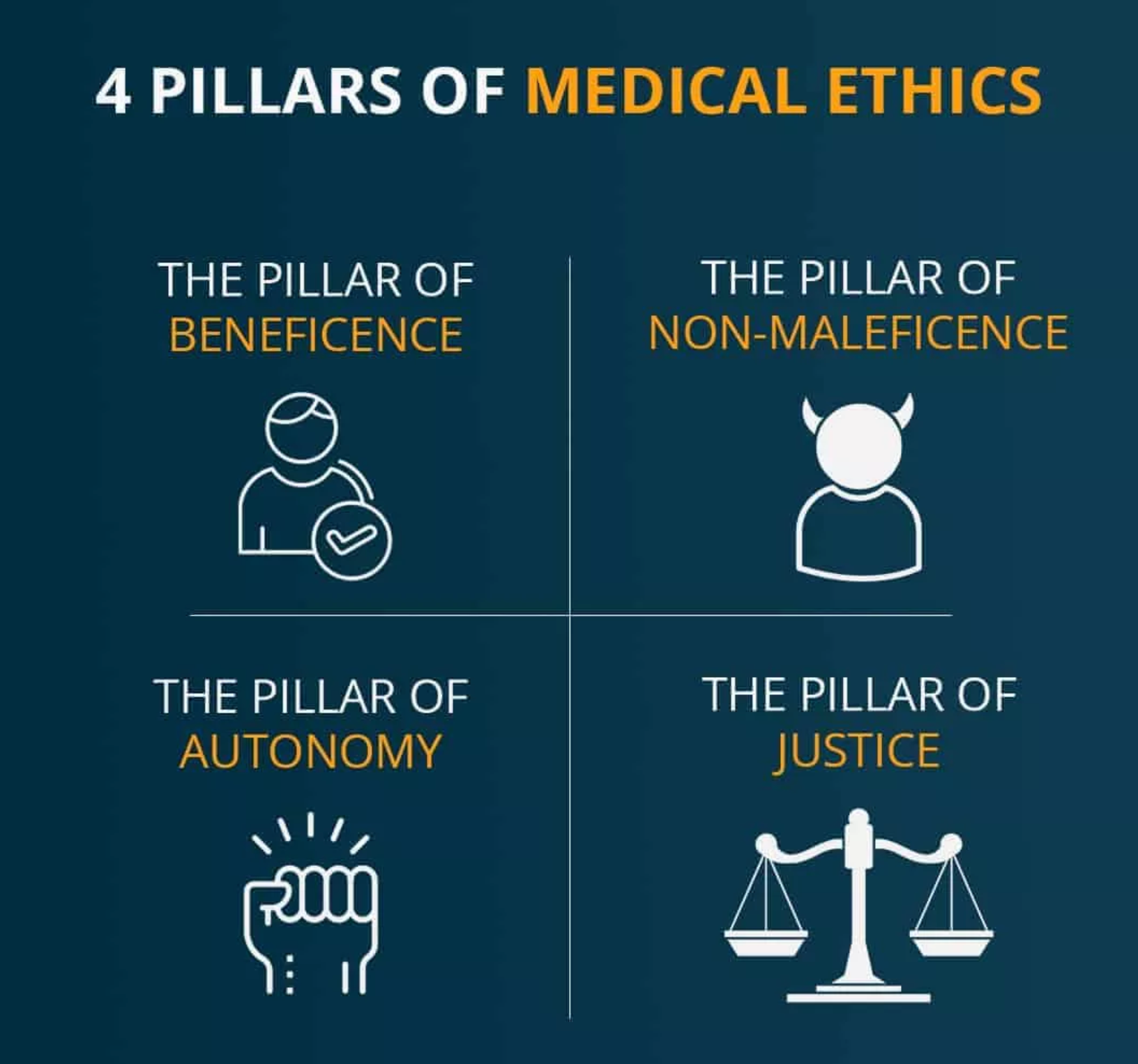
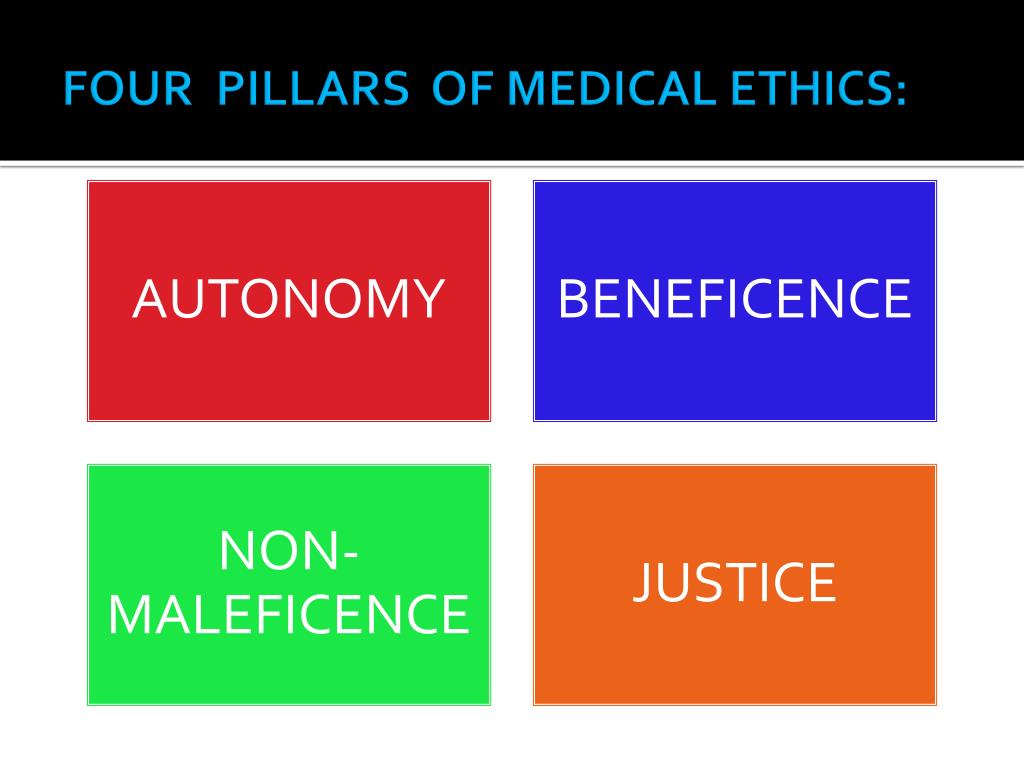
The four pillars are:
- Autonomy: Respecting a patient’s right to make their own informed decisions.
- Beneficence: The duty to act for the patient’s benefit.
- Non-maleficence: The imperative to “first, do no harm.”
- Justice: Ensuring fairness and equity in the distribution of healthcare resources and treatment.
These principles are not hierarchical; they are interrelated and must be constantly balanced. A skilled healthcare professional weighs them in every clinical encounter, ensuring one principle is not pursued at the unacceptable expense of another.
Pillar 1: Autonomy – Respecting the Patient’s Voice
Autonomy recognizes the fundamental right of a competent individual to make decisions about their own body and life, based on their personal values and beliefs, free from coercion or undue influence.
What It Means in Practice:
- Informed Consent: This is the cornerstone of autonomy. It requires healthcare providers to ensure patients understand their diagnosis, the proposed treatment (including its purpose and nature), material risks and benefits, reasonable alternatives, and the consequences of no treatment. Consent must be voluntary, competent, and informed.
- Truth-Telling (Veracity): Patients cannot make autonomous decisions without honest information. This means communicating diagnoses truthfully, even when the news is difficult.
- Confidentiality: Respecting a patient’s private information is key to maintaining trust and enabling open communication, which autonomy depends upon.
A Real-World Scenario:
A 68-year-old patient is diagnosed with localized prostate cancer. His doctor explains all treatment options: surgery, radiation, or active surveillance. The doctor provides statistics on success rates, potential side effects like incontinence or impotence, and quality-of-life implications. The patient, whose primary value is maintaining his current active lifestyle, chooses active surveillance despite slightly different medical advice. The doctor respects this autonomous choice because the patient was fully informed.
When It Gets Challenging:
Autonomy can conflict with other pillars. For example, a patient may refuse a life-saving blood transfusion (Autonomy) due to religious beliefs, while the doctor feels a duty to save their life (Beneficence). In such cases, ethics committees and advance directives help navigate the conflict.
Pillar 2: Beneficence – The Duty to Do Good
Beneficence is the proactive obligation of healthcare professionals to act in the best interest of the patient, promoting their well-being and contributing to their welfare.
What It Means in Practice:
- Positive Action: It goes beyond merely avoiding harm; it requires taking active steps to improve patient outcomes. This includes recommending preventive care, providing effective treatments, and offering emotional support.
- Utility: The action taken should provide a net benefit, weighing the potential good against potential risks (bridging to Non-maleficence).
- Balancing Benefits and Burdens: Treatment must be proportionate. For instance, recommending a grueling chemotherapy regimen is only beneficent if the potential for extending meaningful life outweighs the severe side-effects.
A Real-World Scenario:
A pediatrician caring for a child with a complex chronic illness coordinates with a team of specialists, a physiotherapist, and a social worker. This holistic approach—addressing medical, physical, and psychosocial needs—is a direct application of beneficence. The doctor is going beyond a simple prescription to actively promote the child’s overall well-being.
Pillar 3: Non-Maleficence – “First, Do No Harm”
Often summarized by the famous Latin maxim Primum non nocere, Non-maleficence is the core duty to avoid causing harm to the patient.
What It Means in Practice:
- Avoiding Negligence: This principle mandates that practitioners provide care that meets the accepted standard, avoiding reckless or intentionally harmful actions.
- Risk Management: It requires careful consideration of treatment risks. If a procedure’s risks outweigh its likely benefits, it is unethical to proceed.
- Futility: It obliges professionals to avoid providing treatments that are medically futile—that cannot achieve the intended physiologic goal—as these interventions only inflict burden (pain, cost, false hope) without benefit.
A Real-World Scenario:
Before prescribing a potent new medication, a physician meticulously reviews the patient’s full medical history and current medications. She discovers a potential interaction that could cause a dangerous side-effect. She chooses a slightly less effective but much safer alternative drug. This is non-maleficence in action—prioritizing the avoidance of harm.
Pillar 4: Justice – The Pursuit of Fairness in Care
Justice in medical ethics concerns fairness, equity, and appropriate distribution of scarce healthcare resources. It asks: “What does a person or society deserve?” and “How do we allocate benefits and burdens fairly?”
What It Means in Practice:
- Distributive Justice: This is about fair allocation. During a pandemic, it guides the ethical creation of vaccine or ICU bed prioritization frameworks.
- Rights-Based Justice: Upholding legal and human rights in healthcare settings, such as the right to emergency treatment.
- Non-Discrimination: Patients with similar medical needs and prognoses should receive similar care, regardless of age, gender, ethnicity, socioeconomic status, or lifestyle.
A Real-World Scenario:
A hospital ethics committee uses a transparent, publicly vetted set of criteria to allocate donor organs. The criteria balance medical urgency, likelihood of success, and time on the waitlist, explicitly excluding factors like social status or wealth. This systematic process is designed to uphold distributive justice.
The Pillars in Concert: Navigating Ethical Tensions
The real test of ethics occurs when these pillars conflict. There is no automatic “correct” answer; ethical reasoning involves careful deliberation and balance.
Common Conflict & Resolution Framework:
| Ethical Conflict | Tension Between | Ethical Considerations & Balancing Act |
|---|---|---|
| A patient refuses life-saving treatment. | Autonomy vs. Beneficence | Respect the refusal if the patient is competent and informed. Explore reasons for refusal, ensure no depression or misunderstanding. Involve ethics committee. |
| Allocating a scarce drug during a shortage. | Justice vs. Beneficence (for individuals) | Develop a fair, transparent allocation protocol (Justice) that maximizes overall benefit (utilitarian Beneficence), rather than making ad-hoc decisions. |
| Performing a high-risk, potentially life-saving surgery. | Beneficence vs. Non-maleficence | Meticulously weigh the probability and scale of potential benefit against the probability and severity of potential harm. Obtain robust, voluntary informed consent. |
| Withholding a painful truth from a patient. | Non-maleficence (avoid distress) vs. Autonomy (truth) | Truth-telling is generally paramount. Compassionate delivery of information supports Autonomy without abandoning Non-maleficence. Paternalistic deception is rarely justified. |
The Practical Application: From Clinic to Public Policy
This framework is not theoretical. It guides daily practice and high-level policy:
- In Clinical Care: It structures ward rounds, informed consent conversations, and multidisciplinary team meetings where complex patient cases are reviewed.
- In Research: It underpins Institutional Review Boards (IRBs) which ensure studies respect participant autonomy (informed consent), minimize harm, and are justly conducted.
- In Public Health: During a pandemic, policies balance individual autonomy (lockdown restrictions) with beneficence/non-maleficence (protecting population health) and justice (equitable vaccine rollout).
- In Related Fields: These principles extend beyond medicine. For instance, the 9 GDC Principles governing UK dental professionals are a direct application of this ethical framework to dentistry, covering patient interests, consent, and confidentiality. You can explore this in our detailed guide on the GDC Principles.
FAQs: Your Questions on Medical Ethics Answered
1. What happens when a family’s wishes contradict the patient’s advance directive?
This is a painful clash between the patient’s documented autonomy (the advance directive) and the family’s perspective. The ethical and legal standard is to prioritize the patient’s own prior, competent wishes. The role of the healthcare team is to compassionately communicate this to the family, helping them understand it is about respecting their loved one’s authentic choices.
2. Can a doctor ever ethically override a patient’s decision?
Yes, but in very limited circumstances. Overriding is typically only considered if:
- The patient lacks decision-making capacity (e.g., due to dementia or acute delirium).
- The decision poses a serious and immediate threat to public health (e.g., a patient with active, infectious tuberculosis refusing isolation).
- The choice involves a minor, where parental refusal of life-saving treatment may be legally challenged.
3. How does justice apply to the high cost of some medicines?
This is a central issue in bioethics. The justice pillar forces us to question whether it is fair that only the wealthy can access astronomically priced drugs, creating significant health inequities. It drives debates on drug pricing models, insurance design, and the fundamental question of whether healthcare is a right or a commodity.
4. Are these principles legally binding?
While the principles themselves are ethical guidelines, they are deeply woven into the fabric of healthcare law and regulation. Breaches—such as failing to obtain proper informed consent (violating Autonomy) or acting negligently (violating Non-maleficence)—can form the basis for malpractice lawsuits and professional disciplinary action by bodies like the General Medical Council.
Conclusion: The Enduring Guardians of Trust
The four pillars of medical ethics are far more than an academic exercise. They are the essential guardians of the sacred trust placed in healthcare. In a world of rapidly advancing and often overwhelming medical technology, they provide a stable, human-centered compass. By demanding respect for persons, active good, the avoidance of harm, and fairness, they ensure medicine remains a moral enterprise dedicated to healing. For patients, understanding these principles empowers you to be an active partner in your care. For professionals, they are the constant, indispensable guide for a practice built on integrity.